 When we got back to the USA, after living for 3 1/2 years in a remote village in the mountainous rain forest of Papua New Guinea (PNG), we lived in Cleveland, Ohio for about a year. During that time in Cleveland I worked in commission sales, selling women's clothing at a J.C. Penney store in the Parma mall. While there, I made friends with one of my co-workers who happened to be of Arabic (Palestinian to be exact) descent.
Rowida grew up in the West Bank on the Gaza strip in Israel. Our friendship began several months before Desert Storm in Iraq broke out in 1990. Rowida turned out to be a very interesting woman to know. She was of the Islamic faith, but certainly not traditional, since Rowida did not wear a burka, at least to work. She was a very colorful and commanding personality that often offended and clashed with our other co-workers. Anyway, Rowida and I had many religious conversations. I certainly had plenty of questions about hers and she had numerous probing questions about Christianity. Rowida's mother still lived in the West Bank and basically all of the Palestinians living there were under house arrest and could not leave their homes. This was of major concern to Rowida and I think it caused her to be sympathetic to the Iraqi people during Desert Storm. It also gave me another perspective when the anti-Islamic sentiment in the US began during that time in the 1990's. Anyway, in addition to our religious and political discussions some of our other conversations centered on cooking. Rowida was a traditional Palestinian cook. She often brought samples of some of her cooking into work for me to taste and also shared several recipes including Palestinian Spinach Pies.
I have not seen or spoken with Rowida since August of 1991, when we left Cleveland to move down here to Americus, Georgia. However, it's as if she is standing right next to me whenever I make Palestinian spinach pies. The dough in these pies is not like a typical pastry pie dough. Instead the dough is more of a bread dough.
In my blog post about making a rhubarb meringue pie, which was a recipe of my mother's, I also suggested that I might write sort of a family history based on the "heirloom" recipes collected by my godmother from all of my aunts and significant woman in my life. Sharing recipes definitely provides a spiritual connection between people and there is definitely history for us surrounding our experiences with food, whether eating, cooking or swapping recipes. Every time I make Palestinian spinach pies, I can't help but think of Rowida and about our many conversations. Food is one of those sensual things that can call up all kinds of buried memories. Like music, whenever a certain song is played, memories surrounding our mood, emotions, certain smells, and even what we were doing when we first heard a particular song all come to the forefront of our thoughts -- and food does that to us as well. I have lots of memories surrounding those months that my family & I lived in Cleveland, Ohio 19 years ago and making and eating Palestinian spinach pies seems to bring many of them to mind.

We lived on the west side in inner-city Cleveland, on Archwood Avenue. The West Side Market (http://www.westsidemarket.org/about.html) was a favorite haunt for finding fresh fruits & veggies and also all kinds of ethnic culinary flavors. Even though it was not Papua New Guinea, shopping in this market and hearing so many different language dialects all around, helped ease some of the shock that being back in the USA sometimes elicited. In that same neighborhood were some of the what I called "Arab stores". I could buy fresh -- like still warm, fresh pita bread. I also bought "sumac", a spice that is used in making these spinach pies.
*Also sumac, soumak - Rhus Coriaria, family Anacardiaceae.
This spice comes from the Mediterranean and Middle East, from the berries of a wild bush (although there are many varieties all over the temperate world). It is an essential ingredient for Arabic cooking, favored over lemon for sourness and astringency. It is somewhat related to poison ivy (Toxicodendron radicans).
The berries grow in dense clusters of small, russet coloured, rather hairy berries about 10mm (¼ inch) round. They are dried and crushed into a coarse purple-red powder before use. Quite aromatic, they are sour, fruity and astringent in flavour.
Enough rambling -- here is the Palestinian Spinach Pie recipe:
I can make this in about 30-45 minutes -- excluding the baking time. While my bread machine is mixing the dough, I use my food processor to chop the vegetables (spinach, onion, & tomato)
Preheat the oven to 375 degrees.
Preheat the oven to 375 degrees.
DOUGH:
1 1/2 tablespoon baking yeast
3 cups whole wheat flour (I always put 1/4-1/2 cup flaxmeal in with the flour)
3 tablespoons wheat gluten, optional (This is not part of the original recipe as I got it -- but I like the quality of the bread when I use wheat gluten)
2 teaspoons salt
3/4 cup extra virgin olive oil
1 1/2 cup warm water
3 cups or so unbleached white flour
I mix all of the ingredients, except for the unbleached flour in my bread machine. When this is well mixed, I add 2 cups of the unbleached flour. When that is mixed in, I keep adding more flour until I get a nice soft dough that is not too sticky, but also not too stiff. I then proceed to continue kneading the dough in the bread machine and allow it to sit a bit, when the kneading is finished. If you do not have a bread machine, simply stir together the first 5 ingredients in a large bowl or in a mixer. Then continue to add the unbleached flour. When the dough is too difficult to stir, simply knead in the flour until you get a nice, easy to manipulate dough.
FILLING:
12 ounces of fresh spinach leaves (cleaned & chopped)
1 good sized onion, diced
2 good sized tomatoes, diced
1-2 teaspoons salt (per taste)
2 teaspoons sumac (omit if you can't find it)
2 tablespoons lemon juice (add a bit extra, if you don't have sumac)
3 tablespoons extra virgin olive oil
When I used my food processor to chop/dice my veggies, I processed each vegetable individually and place in a large bowl. I basically used the pulse on & off several times, so that I didn't over-process each veggie. Toss the vegetables together and mix in seasonings (salt & sumac), lemon juice and oil. (This actually makes a very tasty salad and I often eat any filling left-over as a salad!)
FORMING THE PIES:
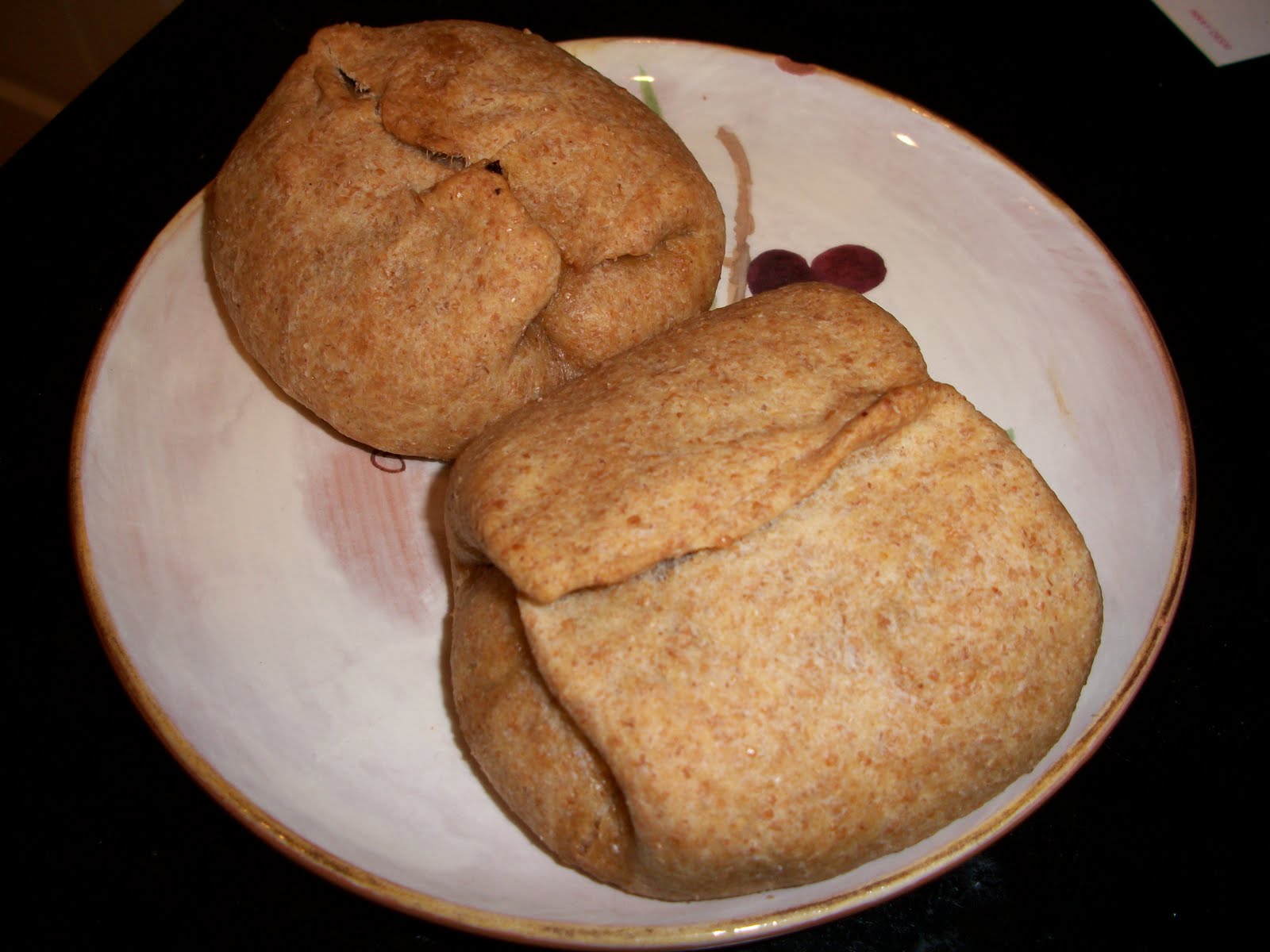
Break the dough into balls smaller than tennis balls -- should make about 15-18 balls. Let sit for 15 minutes. Roll out each ball to about 1/8"+ thickness. (do not make the center too thin). Drain the filling of excess liquid. Spoon some of the filling onto the center of the flattened dough. Fold 2 sides together and then the other 2 sides to completely enclose the filling. Pinch the edges of the dough together to seal in the filling and generously brush with olive oil and place on a cookie sheet oiled with olive oil or covered with baking paper. Make up the rest of the balls and place on the cookie sheet. Do not arrange the pies too closely together on the cookie sheet -- you many need 2 sheets.
Bake in a 375 degree oven for about 20 minutes or more or until the bottoms and the tops are nicely browned.

These spinach pies can be eaten hot or cold -- whichever you prefer. You can reheat them in a toaster oven if you want to eat warm left-overs. They make fabulous lunches -- a refreshing break from sandwiches. Whenever we go on a long car trip, taking these along to eat at a rest stop, rather than eating in a fast food place or restaurant chain adds some nutritious class to the trip. Palestinian spinach pies are a great favorite of my husband and all of my children -- I can't make enough of them at a time or often enough to satisfy everyone's appetite for them! Here's thinking of you, wherever you are, Rowida!!


